
Patient Information
Patients Guide
Your surgeon has scheduled you for a procedure at the Center for Specialty Surgery. Our goal is to provide you with safe surgical and recovery care in a setting this is comfortable and convenient for you and your companion.
This information is designed to answer your basic questions about the Facility and the visit that you have planned. After reading the information provided, make a list of your questions and bring them to our attention. Our trained team of Registered Nurses, Surgical Technologists and Administrative personnel are prepared to help you move easily through your surgical experience.
The Center for Specialty Surgery, LLC is owned and operated by the Orthopedic and Fracture Clinic,PC. Your surgeon feels the Center is an ideal place for the care you need and although you may have other locations you could choose, we are pleased to be providing you with the care you need at this time.
The Facility is located at:
11782 SW Barnes Road Building C Suite #200, Portland, Oregon.
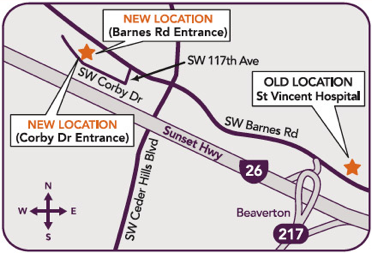
Directions
via Highway 26 West (coming from the East)
- Take Exit 68 Cedar Hills Blvd,
- Turn right onto SW Cedar Hills Blvd
- At the next light turn left onto SW Barnes Road.
- Turn left into Barnes Professional Plaza complex. Building C is located in the Southeast corner.
via Highway 26 East (coming from the West)
- Take Exit 68 Cedar Hills Blvd
- Turn left onto SW Cedar Hills Blvd
- Drive under Highway 26 to the second stop light
- Turn left onto SW Barnes Road
- Turn left into Barnes Professional Plaza complex. Building C is located in the Southeast corner.
Joint Replacement Guides & Classes
To know exactly what to expect before, during, and after your joint replacement surgery, we’ve combined all the necessary information in these printable Guides. Please download here:
If you are scheduled for a Joint Replacement Surgery at CSS, please use the respective link below to access your pre-op class. Each video has a unique password, if you don’t have the password, please contact your surgeon’s office:
Total Hip Replacment: Anterior Approach Pre-op Class
Advanced Directives
To familiarize staff members, patients and their family members with legal responsibilities and facility policies in responding to patient emergencies.
In the event of an emergency or life-threatening situation or need to urgently transfer to a higher leve of care, advanced cardiac life support procedures will be administered during the event of a deterioration; we will always attempt to resuscitate to the next level of care where a pateint’s surrogate can make further decisions on their care.
Advance Directives 416.50 (Q-0224)
Patients who express an interest in formulating advance directives will be given information and referred to their primary care physician. Those that have advance directives should bring a copy to Center for Specialty Surgery so it can be made part of their medical chart.
Scheduling Surgery
Prior to your surgery day

You will visit our the facility where a member of our nursing staff will meet with you and answer any questions you may have about your procedure.

Occasionally, your physician may require pre-admission testing and clearance from your primary care physician. If so, this should be done prior to visiting the surgery center giving us ample time to obtain any test results ordered.

Bring your medication list that you are currently taking (including aspirin).

Any changes in your physical condition such as a cold or fever should be reported immediately.
The Day Before Surgery

Do not eat or drink anything after midnight the night before your surgery (this includes drinking water and chewing gum), unless otherwise instructed by your physician or anesthesiologist.

Arrange for transportation to and from the Center for Specialty Surgery on the day of surgery.

Arrange to have a responsible person accompany you home. You cannot drive yourself because your alertness after surgery is reduced, due to anesthesia and medication.

Minors under the age of 18 must be accompanied by a parent or legal guardian.
The Day of Surgery

Make no other plans for the day of surgery.

Wear casual and comfortable clothing that can be easily stored in a locker.

Please do not wear jewelry, makeup or nail polish.

You may be asked to remove dentures, contact lenses or other prosthetic devices.

Please arrive one hour prior to your scheduled surgery time to prepare for the procedure.
Anesthesia

Upon your arrival at Center for Specialty Surgery, you will be examined by an anesthesiologist who will also review your medical history, answer any questions you may have and discuss the appropriate type of anesthesia to be used.

Local Anesthesia
Numbs only the area being operated on and allows you to be awake during the procedure.

Regional Anesthesia
A portion of the body is “blocked” from feeling pain while you remain awake.

General Anesthesia
You will be asleep throughout the procedure.

Monitored Anesthesia
You will receive medication to make you comfortable during the procedure. This is often given in addition to local anesthesia.
Following Your Surgery

Post-operative doctor’s instructions will be reviewed with you and your family once again.

You may feel somewhat sleepy or dizzy from receiving anesthesia and medication, which is common after a surgical procedure.

When you arrive home have a responsible adult remain with you should you need assistance.

Refrain from strenuous activity.

The day after surgery a recovery room nurse will call you to monitor your progress.
Children

At Center for Specialty Surgery, we are very sensitive to the needs of children undergoing surgery. Parents and children will be able to remain together as long as possible prior to surgery and be reunited when surgery is complete.
Because children often require additional attention after surgery, we recommend that a second adult be present to assist on the drive home. will be asleep throughout the procedure.
Pain Management
We want to work with you to lessen or relieve pain after your procedure. Keeping your pain under control will help you heal better and faster. When your pain is under control you will be able to do your breathing exercises to prevent pneumonia, and regain strength more quickly.
The Key to the Best Pain Control
- Take your pain medication as soon as the pain starts.
- Take your pain medication before you start any activity that might cause increase in pain. It is harder to ease pain once it has started.
Measuring your Pain
We will ask you to measure your pain before and after each dose of pain medication. Rate your pain on a scale of 0-10 – see scale drawn below.

Tell your nurse if your pain is not relieved, if you have nausea, itching, or if your medication wears off too quickly. The pain medication ordered can be adjusted or changed to meet your needs. Studies show that getting hooked on pain medication should not be a concern and this is very rare– unless you have a history of drug abuse. before you start any activity that might cause increase in pain. It is harder to ease pain once it has started.
Forms of Pain Relief
Your doctor will choose the best form of pain control that best suits your needs. Several forms of pain control are:
- Oral, injection or IV pain medication, given at your request or specific times
- Patient controlled Analgesia (PCA) the pain medication is in a pump which you press a button to inject the pain mediation into your system.
Anesthesia Information
Your physician and anesthesiologist will consult with you and develop a plan specific to your needed for the type of anesthesia best meets your situation. You may have one or two types of anesthesia and each have some discomfort associated depending on the type.
General Anesthesia
General anesthesia is a state of medical induced unconsciousness; it is more than just being asleep. Under general anesthesia, your brain does not respond to pain signals or reflexes.
- You may have a sore throat and may use throat lozenges as needed
- Drowsiness is expected for the first 24 hours after the procedure
- You need to notify your doctor is you have nausea that does not go away
Regional Block
Regional block or regional anesthesia is when only a part of the body is anesthetized. This allows for a procedure to be done without your being unconscious.
- Numbness may last 1-8 hours depending on the type of block and medication. When the tingling feeling start you should take oral pain medication right away.
- Protect the numb area from injury until all the feeling and movement has fully returned.
Spinal / Epidural
Spinal and epidural blocks numb your body from the waist down. Similar to regional block, this allows for a procedure to be done without your being unconscious.
- You must have full movement and bladder control before you go home, therefore you may stay longer in the postoperative area.
- A rare side effect is a headache when you stand up and goes away when you lie down. Lie flat and call your doctor.
Nondrug Pain Relief Methods
- Cold packs if ordered by your doctor, no more that 20 minutes on 20 minutes off cycle to prevent burning of skin.
- Slow rhythmic breathing for relaxation.
Once you go home
- If you are given a prescription in you doctor’s office before the procedure, get it filled and take it as ordered as needed after the procedure.
- Some medication causes nausea, be sure to follow directions carefully.
- If your pain is not relieved or gets worse, call your doctor.
- Switch to over-the-counter pain medicine as the pain lessens.
- Increase you intake of water, fruits and vegetables to reduce the side effect of constipation.
Road to recovery starts before your procedure.
- Reduce smoking or better yet stop smoking as far in advance as possible of your procedure.
- Start several days before your procedure to eat healthy and get plenty of rest.
- The day before your procedure, relax and eat on the light side.
- Plan something special that you can do relaxed at home after your procedure such as:
- Collecting those books you’ve wanted to read
- Select the videos you haven’t had time to watch
- Gather albums and plan to sort photos
- Start a daily walk if you haven’t already as soon as possible before surgery, if able
- If you haven’t already, make your post-op appointment and have a better chance of arranging a time that accommodates you.
- It is helpful to have more than one person identified who may drive you to and from your procedure. When possible a caregiver that is available for the first 24-36 hours is advisable.
Financial Policies
Insurance Procedures
Charges
Our charges consist of one fee for each procedure performed. This fee covers Operating Room use (facility fee), supplies, dressings, medications and nursing services. If your surgery involves a special implant or orthopedic implant, these items will be billed separately from the surgery procedures.
Other items that are not included in procedure fees are: anesthesia services, surgeon’s charges, laboratory fees, and durable medical equipment. You will receive a separate bill from each company providing these services. We will be able to assist you with contact information, if you are uncertain about where to call for clarification on these bills.
Questions for anesthesia fees, please contact Doctor Profession Billing Service at: (503) 297-7223.
Insurance Benefits and Deposits
Your insurance benefits will be verified before your surgery, based on the diagnosis and estimated procedures received from your physician. If you have unmet deductibles or coinsurance, our billing staff will contact you to collect these amounts before your surgery date.
As a courtesy, Center for Specialty Surgery will bill your insurance for you. However, the responsibility for any charges associated with services provided to you is yours. It is your responsibility to provide Center for Specialty Surgery with correct insurance billing information and your billing address.
We gladly accept Visa, MasterCard, and Discover for patient’s portion of fees. If you cannot pay your balance in full, please contact our Business Office at (503) 608-5172 as soon as possible after receiving your statement to discuss possible payment arrangements.
Thank You!
We appreciate the trust you have placed in our staff. We will make every attempt to honor that trust by providing the high-quality medical care you expect and deserve.
Lodging
If you travel a long distance and will need the assistance of someone to care for you post-operatively, there is a local temporary living center that can assist with your care. Many of your patients are referred to this facility or for local lodging needs.
Hotels Close to Center for Specialty Surgery

Comfort Inn West Beaverton
13455 SW Tualatin Valley Hwy,
Beaverton, OR 97005

Fairfield Inn & Suites Beaverton
15583 NW Gateway Ct,
Beaverton, OR 97006

Extended Stay America
Portland-Beaverton
875 SW 158th Avenue,
Beaverton, OR 97006

Hilton Doubletree
15402 NW Cornell Rd,
Beaverton, OR 97006

Courtyard by Marriott Portland Beaverton
8500 SW Nimbus Ave,
Beaverton, OR 97008

Hilton Garden Inn Portland/Beaverton
15520 NW Gateway Ct,
Beaverton, OR 97006

Peppertree Inn
10720 SW Allen Blvd,
Beaverton, OR 97005
R&R Program
Who uses the R&R Program?
Post Cometic Surgical patients who need some supervision.
What is the cost? Who pays for the care?
R&R charges for accommodations and supplies are usually not eligible for insurance reimbursement. Fees are payable at the time of discharge from the R&R. Major credit cards are accepted. The fee’s are based on the following:
- One Surgical Procedure: $600/night
- Two Surgical Procedures: $1000/night
How do I make a reservation?
You physicians office will make these arrangements for you if your interested in post surgical care.
Patient's Brochure
To make it easy for you, we’ve combined all the necessary information from this page into a printable brochure. Please download here:
Additional Questions? Call Us!